Thursday, June 30, 2011

Vintage Lady-ness


A Facebook friend of mine posted the following line from Andre 3000's "Behold, A Lady" to her status the other day:


Sad, but one day our kids will have to visit museums to see what a lady looks like.


I think this is the opposite of sad. I think this would be a genius moment in human development. Not because I dislike femininity, or because I have a problem with women who wear high heels or whatever. But because the culturally-constructed version of "lady" that Andre 3000 is praising here as the height of desirability is something a great many women would find oppressive, both of your faithful bloggers included. For instance:

You don't say too much, but when you do it's profound.

Reeeeeeally? That's not going to work for me. What is "too much," and why does Andre get to decide what that is? Why is he the arbiter of "good girl"?

I realize that this is an old song now, but these are sentiments I still hear ALL the time. We would be better off if we got rid of this idea that there is a way a "lady" behaves, and that this is preferable to... the way an unladylike woman behaves? I don't think I behave in a lady-like fashion with any kind of regularity, and I feel great about that. Because too often "lady-like" is equated with submissive, quiet, accommodating, undemanding, etc.

Furthermore, I'm assuming that the only people Andre thinks should be ladies are cis women. Men should be gentlemen, of course. A man who behaves like a lady is twisting up the gender spectrum too much, rendering it unintelligible to someone so concerned that women behave in a way he finds pleasing that he wrote a whole song about it.

And what about queer women? What is the point in a lesbian, for instance, behaving like a lady if there is no gentleman counterpart? Do lesbians not exist in his world, or does he see them as not-women, or does he just not care because he can't sleep with them anyway? And trans women - do they have a hope of being lady-like?

Prescriptive gendered behaviors are a big problem for me, because they define anyone who is not adhering to an unobtainable standard as deficient. Not particularly interested in wearing heels and walking in a way a man might find appreciably sexy? Then your very womanhood is in question.

So, I hope that we have to go to museums to see what we used to think of as the ideal of lady-likeness looks like, because that would mean that we've stopped policing gendered behaviors. Women who still choose to present themselves in a way that aligns with Andre's version of femininity would be free to do so without having to do so for a man. And a man who presents himself in a way that aligns with Andre's version of femininity would be doing so freely as well.

Wednesday, June 29, 2011

On "Honor"

Reader, your faithful blogger is kind of flagging, so today you get an unstructured, but blessedly short, rant about "honor." Ready?

I've had dudes tell me, straight to my face, that men have "honor" and women don't. This is so antiquated, and I hate it. I especially hate it because I'm rather invested in trying to be an honorable person myself. For me, this mostly means "you do the shit that you say you're gonna do," which is related to a whole bunch of other things. Not being a hypocrite. Being punctual. Not trying to get away with shit I know I shouldn't be doing. Checking with friends before I date their exes. Washing and ironing cloth napkins for the rest of my life because I convinced my mom to switch from paper when I was a kid and it just seems fair that I should have to do so as an adult, too. That sort of thing.

None of this should be gendered; women are quite capable of being honest and conscientious in any aspect of life, and if you disagree you are profoundly misogynistic. Also, dumb -- why would we (on average) entrust the less honorable sex with raising our children? Yet this particular combination of reliability and ethics that we call "honor" is peculiarly gendered, and I don't understand why. It's something that we should all strive to embody, regardless of our gender.

Tuesday, June 28, 2011

NYC Pride: A Photo Essay

So I went to New York City to hang out with my awesome brother and sister-in-law for Pride this year. It was well worth the time and effort, but now I'm too tired to think, so y'all are getting a photo essay. I promise to write overly windy posts again soon.

But first! Yes, marriage equality passed in New York on Friday. This is good news, to be sure, but I would also like to alert you to the fact that the Gender Expression Non-Discrimination Act has been languishing in New York for three years. Let's not forget our trans and gender-queer siblings here, okay? Get to making phone calls. You know what to do, New York.

On to the pictures!


This is me and my lovely sister-in-law, Becky, at a queer women's dance party. We had a blast, and got rainbow-colored skin right from the beginning.


Becky really loves rainbows. A lot, you guys.


And this is my badass brother, Jordan, who also loves flags. They make him feel patriotic, apparently.


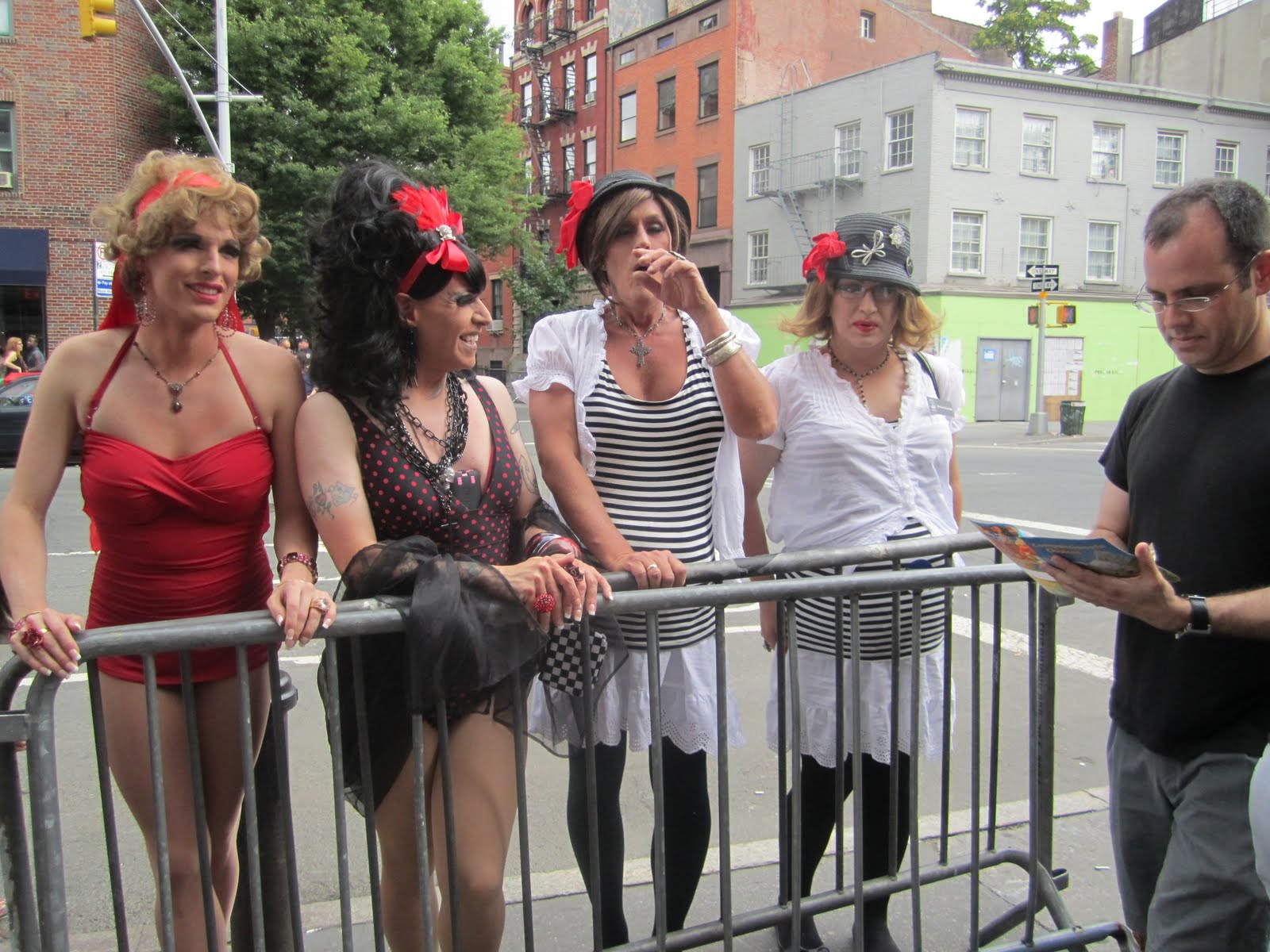
Y'all know I love some drag queens, and these ladies were fierce.


Of course people dressed their dogs up for Pride. I hope these puppies signed a photo release, because I'm guessing they'll be in every publication in the city.

The parade was really fun. I honestly don't remember which float this was, but it had cool music and looked awesome.

And these people were ice skating on a float in June. Really pretty badass.


This lady out-rainbowed even me!


Me and my brother, before I got fully rainbowed. The shoes are Kyrie's, and I luff them. She was very generous to let me wander all over NYC with them. I might give them back, if she's lucky.


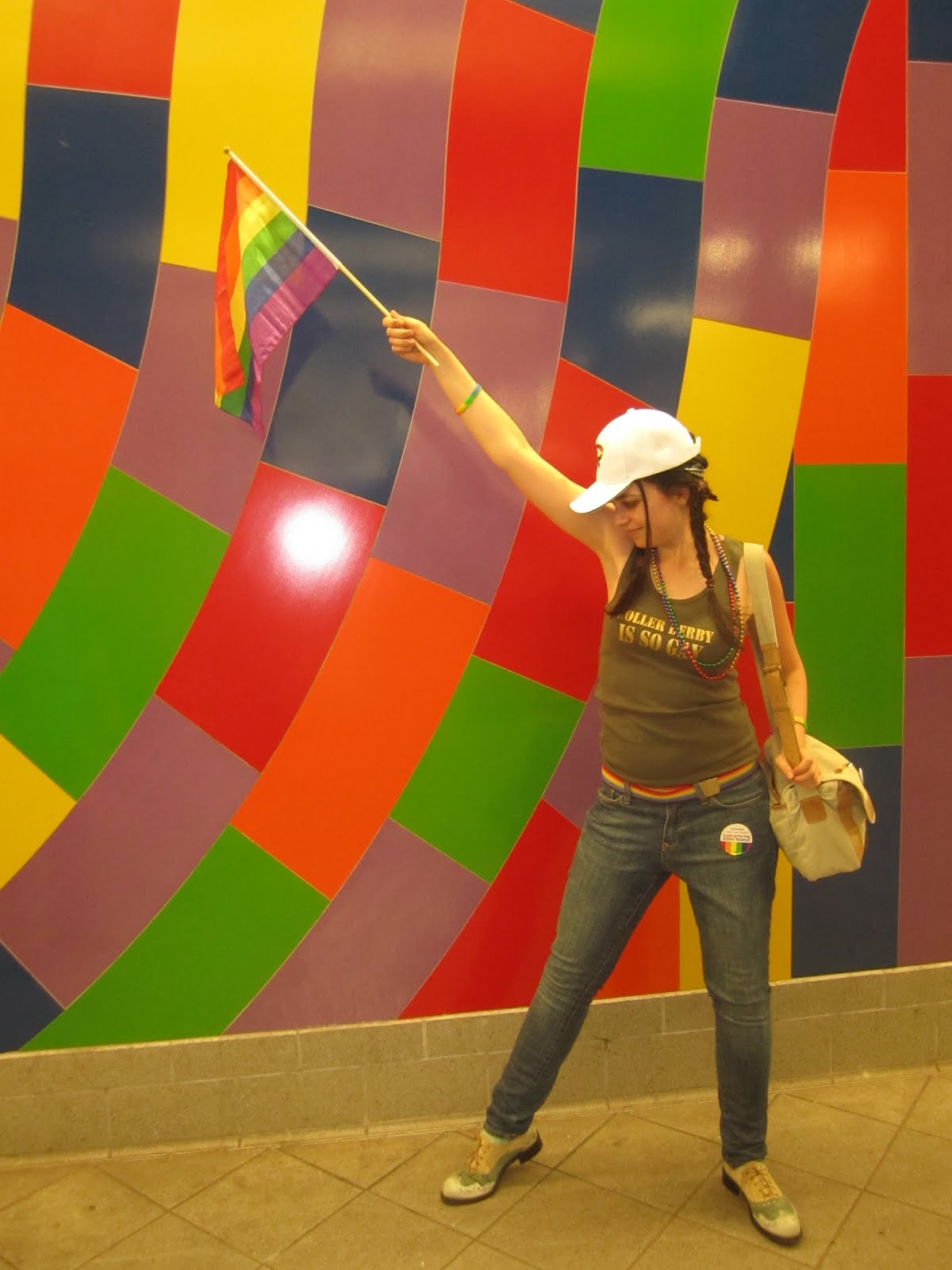
Jordan and Becky played "decorate the lesbian," and this is what happened. What you can't see are the rainbow tattoo on my arm and all the gay pride buttons on my bag, and my shirt says "roller derby is so gay," but I think you get the point. If Becky could score it for free and it had a rainbow on it, it was ours.


And, finally, the train station itself was very gay. A nice way to close the weekend, I think.

If you went to a Pride festival and want to e-mail us pictures, I'm happy to do another photo essay.

Monday, June 27, 2011

Those Who Live in Glass Houses

One of the downsides of NWF is that Jess and I represent a pretty limited demographic. We are both highly educated, highly privileged white American cis women. As a result, there are a lot of topics I'm just not able to write about; for instance, a friend suggested that I post an opinion piece about the hijab, and I had to refuse. It's not my place, you guys. (Though we would be delighted to receive guest posts from readers who do have the perspective we lack on these kinds of issues.)

I also think that critiquing other cultures sometimes serves as a way of ignoring our own issues. Things are not all hunky-dory for women in the U.S. The pay gap sucks, abortion access is continually under fire, and one in six women has been the victim of sexual assault. This is no post-feminist utopia. And when helping our sisters internationally, we need to listen and help them with issues they deem important.

The U.S. is definitely a glass house when it comes to gender inequality; I was reminded of this yet again when a reader posted a link to our Facebook page discussing the preference of American men for sons (49% would prefer a son, 22% a daughter). In a poll of over a thousand individuals, presumably half of which are men, that is a statistically significant difference. I have often heard the Chinese criticized for their valuation of sons, particularly in the context of that country's one-child policy and its claimed effect on the sex-ratio at birth. Yet it seems this is an attitude that we share, to some degree; who knows what our sex-ratio would be under similar circumstances?

Friday, June 24, 2011

Which Nomadic European Ethnic Group Do You Hate, Exactly?

Okay, I've had this conversation now with several people, so I might as well write a quick blog post about it. Y'all, it's racist to talk about "gypsies" stealing your shit.

I get that some people may not realize that "gypsy" is an ethnic slur, but it is. It lumps together a large number of ethnic groups under one pejorative term: Wikipedia will tell you that. I don't care if you've met folk who belong to one of these groups who call themselves "gypsies;" that's called re-appropriation, and they get to do it, and you don't.

I have a bigger beef with the representation of all members of these ethnic groups as "thieves." Look, making generalizations about any ethnic group is generally a bad idea. Even supposedly positive stereotypes are often problematic. So just knock it off. We can talk about how things vary by nation or by culture without relying on stereotypes. "I've heard there's a lot of pick-pocketing in Barcelona" is fine. "Watch out for all the gypsies in Paris" is not.

Thursday, June 23, 2011

Pride and Prejudice and Nice Guys™

She seriously does not want to be dancing with this dude.
Here at NWF we are divided in our opinions of good old Jane Austen. Jess would like to "dig her up and hit her over the skull with her own shin-bone," a la Mark Twain, whereas I genuinely enjoy many of her books despite an admittedly increasing frustration with the extreme limitation of the characters' lives. This post is not, however, a defense of Jane Austen.

Rather, I'd just like to point out something kind of interesting I noticed in Pride and Prejudice. Now, this novel is basically the chick lit prototype. Rare1 is the woman who has neither read the book nor seen its adaptations. And dear lord are there a lot of adaptations. Clearly the book continues to resonate with large -- very large -- numbers of women.

Simultaneously (and this is relevant, I swear), straight women are frequently accused of choosing partners poorly. And by "choosing poorly," I'm referring to our supposed collective love of bad boys. Of course, this is ridiculous; genuinely nice men don't come in last, it's just that creepy, manipulative men tell themselves that the reason they have romantic difficulties is because they're "too nice." Blecch. But don't take my word for it, let's take a look at one of the best-loved pieces of chick lit from the last couple hundred years.

As everyone knows, the book details the interaction between Elizabeth Bennet and Mr. Darcy. Basically, Mr. Darcy quickly falls in love with our protagonist, because she is pretty and spunky in a socially-sanctioned Jane Austen kind of way. But he's rather an ass to her in the first half of the book, and she is having none of it. When he begrudgingly proposes marriage to her halfway through the novel (he may love her, but he's not thrilled about it) she tears into him with a speech that is shockingly blunt, particularly after half a novel of antiquated etiquette. The lady is not playing hard to get, she's not secretly in love with him, he's been an ass to her and she's pissed off.

Frankly, the novel could end there, as it's immensely satisfying. But Elizabeth's words hold up a mirror for Mr. Darcy, and he doesn't like what he sees. He then sets about changing himself, and reappears in the second half of the novel with vastly improved social graces. Elizabeth Bennet also finds out about some generous acts he's performed, and, depending on the adaptation, sees him in a rather wet shirt, and the net result is that she obtains both first and second-hand information that dude is not a total d-bag, and can actually be a pretty stand-up guy. Then she falls in love with him.

And, y'all, it's not all about him changing for her, either, because a lot of what changes her mind is finding out about nice things he's done for other people. It's just this: when she thinks he's a bad boy, she has absolutely no interest. When she finds out he's actually a pretty nice man, she develops an attraction for him. There you go, that's the whole plot. Hopefully this is one more nail in the coffin of the idea that nice guys come in last.


1EDIT: I would like to point out that by "rare," I meant in the U.S., and probably within the white population of the U.S. As a commenter has pointed out on our Facebook page, the appeal of this book is demographically limited, and that's good to keep in mind. It certainly does not represent the hopes and fears of women collectively, but is rather a reeeeeeeally popular piece of chick lit that provides a great counterexample to the "we're into bad boys" stereotype.

Wednesday, June 22, 2011

What is a Woman?

Like I've said before, I am thrilled to be making friends and influencing people through this blog. Thank y'all for reading. I've noticed that this blog is serving as a point of introduction to trans issues for some of you; I've been frequently asked to explain terms like "trans man" and "cis."

So, first of all, I am not an expert in trans issues. Not not not. I hope to heck all of you read the book club book, because Wilchins is an authority on the topic. Nevertheless, I would like to say a few things on the subject, because
  1. It's difficult to explain "trans" without defining "man" and "woman," and
  2. People seem to want to rephrase what I do tell them in cissexist language.1

It really is difficult to define "man" and "woman." Yes, many humans have either an XX or XY genotype. Many, not all. It is also possible to be XXX, XXY, XYY, one of several other variations, and to have mosaicism. Even if you fall into either the XX or XY category, these chromosomes may not necessarily determine your sex. For instance, individuals with androgen insensitivity may be XY yet develop a vagina and, later, breasts. Such individuals are usually raised as female and consider themselves women, so it makes little sense to call them "men." Physical characteristics are also not useful for creating a strict binary, as somewhere between a tenth of a percent and two percent of newborns (depending on what criteria you use) have so-called "ambiguous" genitalia (i.e., genitalia that do not fall neatly into one of the two favored categories) and may be considered intersex. These issues were highlighted recently by the ridiculous farce over Caster Semenya's "biological" sex; really, there is no medical test on Earth that can determine a person's sex.

Even if there were a perfect biological binary, we'd still run into trouble, because we've layered so much cultural meaning onto "man" and "woman" that nobody fits into either mold. I'd try to separate sex and gender, but the reason that evolutionary psychology studies are so damn popular with the media is that we are heavily invested in the idea that culturally constructed gender binaries (boys like trucks! girls like dolls!) are fundamental and important and purposeful. So, since nobody else wants to separate sex and gender, I'm not going to either. I think both binaries are bullshit.

"But," you may say, "this is a feminist blog! You talk about women's issues all the time. How can you do that if you don't have a definition for 'woman?'" As it turns out, I do have a definition for "woman." And it's actually really simple. It is "a person who calls themself a woman."2

Any attempt to label some of these women as "real women" or "bio women" is cissexist. We're all real women. If you're a woman you're a woman, and your body is your body: therefore, your body is a woman's body. Now, I'm not trying to tell people how to identify themselves and their bodies; if a someone identifies as both "woman" and "man" (or neither!) we should be able to deal with that, and if someone identifies as a "woman" but calls their body "male" that's their choice, too. But if someone identifies as a woman and you insist on calling their body "male," that is not okay.

We do sometimes distinguish cis women from trans women here at NWF, usually when we want to discuss transphobia in general or cite the experiences of a self-identified trans person. But when we say "women," we mean all women.


1I am far from perfect in avoiding cissexist language myself. While I feel like I did a reasonable job in my post on birth control, I failed miserably in my post about matrilineage. For what it's worth, you have my apology and my assurance that I am working on it.

2This is admittedly a cyclic definition, but, as Jess quoted Judith Butler to me earlier today, "Gender is a kind of imitation for which there is no original." In this situation, what kind of definition but a cyclic one can possibly be given?