Showing posts with label queer stuff. Show all posts

Thursday, March 1, 2012

Semi-Guest Post: Gay Agenda at Toys R Us


Hello, faithful Nth Wavers! Thanks to the continuing ridiculousness of my schedule, I'm still having trouble finding time to write. I will find a way to resolve this, but in the meantime, I pounced on a Facebook post from Alert Reader Andrew, who lays into the bigotry of One Million Moms and their rampage against Toys R Us for allowing something gay to happen in the proximity of their stores. I'm gonna give y'all some background and then let Andrew take it from there, k?

One Million Moms, for those who don't know, are a bunch of hate-filled parents who are terrified of all things queer and also of having conversations with their kids. I'm not gonna link to their site here, because I trust you can all use Google if you really need to know and I'm not into giving them more hits. They're upset because Toys R Us is carrying Archie comments, and Archie has a gay character who got gay married to his gay partner.

Andrew leads with this quote from that story (what's to follow is from him):
Unfortunately, children are now being exposed to same-sex marriage in a toy store. This is the last place a parent would expect to be confronted with questions from their children on topics that are too complicated for them to understand. Issues of this nature are being introduced too early and too soon, which is becoming extremely common and unnecessary.
Ah, yes, the toy store, the last virgin wilderness where parents can be sure that all things their children see won't raise awkward questions...

Let's have a gander at a small sample of toys that can be seen at Toys R Us:
1) Animals devouring carcasses of other animals and leaving only the skeletons

2) Medieval siege engines with attached prison cages

3) Robbers

4) Pirates

5) Poachers

6) Armed cops arresting thieves

7) Lots of forts, cannons, and other military scenarios

8) Secret agents

So One Million Moms feels fine explaining war, conquest, pillage, theft, animal cruelty, the natural order, torture, espionage, and other things but they find it inappropriate that two men who love each other are getting married? Damn. Those are some priorities. (I'm not saying kids shouldn't learn about other things, but I don't know that it's easier to explain why Mr. Lion ate Mr. Fluffers than to explain that Steve and John love each other and are getting married.)

In the words of Archie CEO:

We stand by Life with Archie #16. As I've said before, Riverdale is a safe, welcoming place that does not judge anyone. It's an idealized version of America that will hopefully become reality someday.

We're sorry the American Family Association/OneMillionMoms.com feels so negatively about our product, but they have every right to their opinion, just like we have the right to stand by ours. Kevin Keller will forever be a part of Riverdale, and he will live a happy, long life free of prejudice, hate and narrow-minded people.

Not all available at Toys R Us, but here are Play Mobil sets of questionable virtue for children.

***
Hi! It's Jess again! I'm interested in what parents who aren't bigots have to say about all of this, of course. And if anyone else wants to write a guest post to help a grrl out while I'm getting my act together, I'd be most appreciative. Otherwise, you're probably going to get a lot of nerdy "here's what I learned in the archives today!" posts for awhile.

Love y'all!

Tuesday, January 17, 2012

On Coming Out When You're Famous


Or, at least, semi-famous.

I'm kind of a comedy nerd, and I've long had mixed feelings about that. Sometimes I get disgusted with comedians - most frequently straight white dudes, but not always - who use their comedy to pick on people with less social capital than them. Misogyny, homophobia, and transphobia are frequently part of comedians' acts. I'm looking at you, Andrew Dice Clay, Patrice O'Neal, Steven Wright, Tracy Morgan, etc.

But there are some comedians out there whom I usually feel are reliably progressive and cool. Jimmy Dore, for instance, frequently talks about how he believes that it's okay to pick on people with more social capital than you (Wall Street CEOs) but not less (homeless people). Louis CK, while sometimes a raging gender essentialist, can call out racists like you wouldn't believe. Jamie Kilstein not only does expressly political comedy, he hosts a podcast about progressive issues meant to counter the shit we get from the mainstream media. And Todd Glass, who used to co-host a podcast with Jimmy Dore, has been calling for homophobes to kill themselves for at least the last five years, which is about as long as I've been following his career.

Glass used to - and still does - talk about how people opposing gay rights and shit like that in the 2000s is like someone calling for segregation in 1989. It doesn't make sense, and people are going to be embarrassed as shit about this later, or at least, so we hope.

Well, yesterday, on fellow comedian Marc Maron's podcast, Todd Glass came out as gay. I sat down on the floor of my dining room and just listened to Todd talk about his experiences as a closeted gay comedian and didn't move for a solid 45 minutes. Then I re-listened to the podcast this morning, and I'll probably do it again later today. At first I wasn't convinced it was for real, but it is. Todd Glass is gay. This is really, really great.

It's not just great because I think gay people are great - though it is for that reason also - but because Glass is a really famous comedian. He's had enormous levels of success in the field, appeared on Last Comic Standing, and is frequently referred to as "the comedian's comedian." He's brilliant. And now he's out, and people like Dice Clay and Morgan and those other shitheads who know him are going to have to think again about their homophobic shit because one of their friends is gay now.

What got me super teared up was his statement that he's coming out now because he can't watch any more kids kill themselves and stay silent. He's 100% right. People need to come out, we need to be out, because, as I've said before, it's making the world safer.

Caveat: Don't come out if it's not safe for you. I get it. Some of us are privileged to be able to be out and not lose our homes or put ourselves at the risk for violence from family or roommates or whatever. Not everyone is. This is important.

I wrote a gushy e-mail to Todd Glass and I'm sure he's going to get more of those. People everywhere will be as delighted and filled with warmth as I am, I hope. If I could give Todd Glass a huge hug, I would. I'm so glad he's using his privilege to help people. He alluded to starting a campaign of some kind to help kids. Todd, I eagerly await the details. I'm so proud of you.

Monday, January 2, 2012

Silencing Efforts: It's Time for the Homophobic Student Evaluations


In the last year, my university switched to online student evaluations. This is bad in the sense that fewer students fill them out, and when they do, tend to spend less time on them. But it's kinda cool in that I get to see them much sooner and, if a student raises a point I want to consider, I have time to implement it before I'm halfway through the next semester.

I don't want to seem like an egomaniac or anything, but I'm a pretty good teacher. I've won the university-wide teaching award, and my evaluations are generally quite positive. This semester, some students wrote some particularly sweet and lovely things in their evaluations, and I find this quite touching, and encouraging. I also find it necessary to my survival in this field, because I also got a handful of students who wrote that they wished I didn't talk about queer stuff so much. They talked about my "gay agenda" and how I'm apparently biased.

They're right, you know. I do have a gay agenda and I'm totes biased. My agenda and bias paid off, though, because I made my classroom safer for some of my kids, the ones who feel uncomfortable and unsafe in other settings. That I didn't uphold heteronormativity, as was expected of me, or pretend to be "neutral" on these issues, is good. It's also fucking scary as hell. I don't want to stop teaching, ever.

Part of the reason I think that the kids felt like we talked about queer history so much is that they never hear about it anywhere else. As Kristen said, any amount of discussion about queer stuff above 0% is a lot to them, because it's novel. But I've written about how it is essential to teach queer history before. And because I like it and I can, I'm going to go ahead and quote Feinberg again here:

I always wanted to leave something important behind. Remember the history book you gave me for Christmas?... I've been going to the library, looking up our history. There's a ton of it in anthropology books, a ton of it, Ruth. We haven't always been hated. Why didn't we grow up knowing that?... It's changed the way I think. I grew up believing the way things are now is the way they've always been, so why even bother trying to change the world? But just finding out that it was ever different, even if it was long ago, made me feel things could change again. Whether or not I live to see it. At work, when everyone else is at lunch, I've been typesetting all the history I've found, trying to make it look as important as it feels to me. That's what I want to leave behind, Ruth - the history of this ancient path we're walking. I want it to help us restore our dignity.
- Leslie Feinberg, Stone Butch Blues

Remember that? So, so important. My queer kids aren't finding themselves in history in other classes, so it's my fucking responsibility to make sure they find themselves in my class.

A lot of these students are wrestling with the idea that anyone who isn't a cis straight white man has bias. Because I'm out to my students, I take great risk, as do all out people in education everywhere. I can't cave to their expectations that I will be neutral. It's not possible for me. I'm not neutral. Neutral means invisibility, and invisibility means death, in the most literal sense. Queer kids are killing themselves, getting kicked out of their homes, running away from abusive situations. Am I supposed to be quiet when my kids are dying? Fuck that. I'll take making some privileged straight kids annoyed or uncomfortable over letting kids die because they think they're alone.

I wrote about a study awhile back that talked about how openly queer teachers are negatively reviewed thanks to "modern homonegativity" (the "I'm not anti-gay but..." shit), and - more interesting to me - comments on the study that come from people in the field, some of whom are openly queer. I'm going to re-post the comment I liked the most from the Inside Higher Ed piece here, and I want to emphasize that he's talking about doctoral students:

Michael Dumas: Interestingly, I just taught about LGBT issues last night in a doctoral class on diversity in education. The course is taught by two instructors, both African American, one straight-identified female, and one gay male (me). If this year's student evaluations are similar to last year's, I fully expect to see one or two students complain that "too much time" was spent on gay issues, even though the LGBT content is--coincidentally-- only about 1/10 of the subject matter covered. I also can expect similarly critical comments about how much time was spent on race and African Americans, even though both instructors are conscious about including other populations in readings, media and examples. I don't want to comment on methodological rigor of the study without reading it, but I can say that it is consistent with my experience, and that of a whole range of LGBT, women and people of color in the academy. And yes, negative and untruthful course evaluations can hurt one in the tenure and promotion process.

 Now, as for the question raised above about why a professor would reveal her or his sexual orientation, the study states that sexual orientation was indicated in the autobiographical statement given to research participants. It did NOT say that instructors listed their sexual identity on the syllabus itself! And yes, students do talk amongst themselves about who their professors are as people; they see photos on our desks; they know about our involvement in various advocacy groups on campus; and, importantly, they make assumptions based on gender performance (length of hair, style of dress, speaking voice). So it is entirely reasonable that a student would be aware of, or at least presume, specific sexual identities.
Yesssssssss. You can go back to my earlier post on that, linked to above, to see my commentary on it. I'm posting it here for therapeutic reasons. I needed to read that again.

Look, I don't expect that my department is going to let me off the hook for the homophobic evaluations, ever. I have every expectation of having to explain myself. And so I wrote this post in large part to strengthen myself. I need to have all these thoughts at the top of my head when I get called in for the meeting. Maybe I will be surprised, but I expect that someone will tell me to tone it down, or be strategic, or talk about queer stuff less. I'm hoping the folks in my department will be allies, but I'm never sure. And isn't that a problem?

Image via.

Friday, December 30, 2011

Gay People Can Be Homophobic Too


As anyone who's read this blog for half a minute surely realizes, Kyrie and I are really not into the bigotry thing. I don't care who it's coming from. I don't give people passes on bigotry for any of the following reasons (or any other reasons):

1. I know them.
2. I like/love them.
3. I am related to them.
4. They're smart, professional, good at their jobs, famous, whatever.
5. They have friends/relatives belonging to the group against which they are bigoted.
6. They themselves belong to the group against which they are bigoted.

That last point is called "internalized [homophobia/racism/misogyny/whatever]." It happens all the time. Therefore, having gay friends or being gay is not an excuse to be homophobic.

Sidenote: If you know me IRL, and you've ever said that I'm your lesbian friend in order to seem cool for having a lesbian friend or to make yourself sound like less of a bigot, we're not really friends.

People who think or say things like visibly queer people are just trying to get attention really need to check themselves. For starters, they're trying to police other peoples' self-expression. There are a lot of gay people out there who want us to all just be more heteronormative because they think it will make things easier for them in some way. Like, if we can be just like straight people, everything will be fine. We won't piss off straight people, and we need them, or so this argument goes. We'll get to have marriage or whatever the fuck.

Break to remind you that I don't really care about gay marriage beyond "queer people should have access to institutions that exist." It isn't the end of the struggs. Aaaaaaand: fuck needing straight people to like us, and avoiding pissing them off. I'll piss off straight people all day and night if it will make things safer for one queer kid. That's why I posted the picture of my tattoo again.
My silences have not protected me. Your silence will not protect you.
That's Audre Lorde. Again. Always.

Some of us don't want to be just like straight people. Also also, not all straight people are the same [really!]. Plenty of straight people aren't into the normativity project either.

The idea that we should all be more normative and less visibly queer is super gross because it's upholding the idea that we should be a certain way, and that way is rooted in cis privilege and heteronormativity. My friend Kristen and I are having this conversation about good bodies and bad bodies, or heterocapitalistic bodies/rebellious bodies. She mentioned an old livejournal that basically criticized people for looking too dykey. Whatever that means. As she said, in her brilliant way with words [this was an IM conversation, you should read K's blog for other really interesting stuff]:
it was like you could be femme or androdynous but you had to be really skinny and well dressed, and people would get called like butch and bulldyke and stuff. which is homophobia, right, that you draw a line around skinny femme girls and skinny justin beiber girls and use homophobic language/policing to keep everyone else out. the same way LGB organizations want to keep out people who are trans and sex workers (good gay/bad queer) (bodies that conform to heterocap logic/bodies that rebel)

This idea that queer people should be less visibly queer is a way of telling us to get in line with the heteropatriarchy and I'm not having it. It also reifies the idea that there is a gender binary that exists, and men should look/act/be a certain way and women should look/act/be a certain way and there is a limited range of expression within that. You already know I think that's bullshit.

BUT there's also this whole other thing, which is that without visibly queer people - those of us who read super gay wherever we go or who work our asses off to raise queer visibility in all kinds of ways or who are "professional gays" or all of those things or lots of other things - without us? You don't get a movement, you don't get any progress at all. Conforming and limited- or in-visibility can work for some people, I guess, but Stonewall didn't happen because of people who tried to be under the radar. The people who have the most to lose are often the ones who suffer the most from heteronormativity/patriarchy/capitalism. If you think that that's just a way of "getting attention," you've got another think coming.

And all of this shit is stuff I've heard from gay people. There are gay people out there who want many of us to stop "trying to get attention" by "flaunting our sexual orientation." These people are not my people, I don't care if they're gay. They're homophobic. And they need to learn their history and open their eyes because their homophobia really hurts, and the people it hurts are often the people out there doing the most and/or taking the most shit because of the homophobia that these attitudes hold up.

And if any of them ever tell me I don't look gay again, I'm going to flip a table over and leave.

Wednesday, December 21, 2011

PENIS MOM HAHA BECAUSE MOMS DON'T HAVE PENISES!


Except that some moms do. More on this in a moment.

First, a sidenote-style bit of business. I pulled my last blog, the one on Jane Ward's article about the relationships of trans men and femme ladies, because she wrote to me and said I mis-represented her. She offered, generously, to speak to me on the phone about it. I shall do that, once we set a time, and then revisit the topic.

Now, on to today's lesson. A person - Elizabeth, we shall call her, as that is her name - posted the link to this story on my Facebook wall. It's about a mom who objected to her school's solicitation of dads to help out with a construction project for a kids' activity. Go skim it, it's a quick read.

What follows is a summary of the conversation I had with Elizabeth. If I get her permission to quote her, I'll edit this and do so. Until then, I'll paraphrase.

I like the Penis Mom post all right until this part:
Ladies, this is not a situation of the men holding us back - we are holding ourselves back because we don't want to step forward if it is icky and muddy.
I think that's gross, and it's blaming women for hetero-patriarchal assumptions about gender norms, 100% of which are socialized. Some people like playing in the mud, and some don't, and the principal's assertion that SHE is a PROPER woman is ridic. But women aren't oppressed by the patriarchy because they don't like mud and to argue that they are is asinine.

Elizabeth pointed out that there's a lot of interesting stuff aside from that quote, including the fact that the word "penis" is somehow considered inappropriate for teenagers. She's right, I shouldn't just focus on that one sentence.
Parents who think 13 year olds are too delicate to hear the word "penis" (imagine if the word had been "vagina") are probably totally terrified of sex as a concept and refuse to believe that their kids will engage in it and are probably also really into regulating the sex lives of strangers. Such people include those who are anti-choice and those who think that gay people are sinners. All three concepts are equally silly/awful.

Her larger point that it's intensely retro for anyone to argue that dads and not moms are the ones who should be invited to this is a good one. The concept the school folks were working with excludes anyone who doesn't come from a hetero two-parent household, really. And it tells the boys that they'd better be ready to set up a trébuchet and girls that they'd better never be into that. [And that no other people exist besides boys and girls.] Ugh. Heteronormativity for the win, again, some more. This is all gender training.

Also: I find it's much easier for us to get all up in arms about this kind of thing than it would be when dads are excluded from shit dealing with baking or whatever. You know? It's more acceptable for the weak to mimic the powerful than the other way around. I want to see this level of outrage around men not getting invited to after-school sewing shit and boys who want to wear dresses and whatever.

Elizabeth said she's not sure what to do about that, and I said: "About what?
People who think that it's okay for women to, in at least some areas, tack to the more masculine activities, but it never appears to be okay for men to do things coded as feminine? Throw a fit about it. Like this lady did. And keep throwing fits about it."

There's also the issue that we can too easily erase people who are not male or female, or who are not men or women, or who are not masculine or feminine. If we can get rid of these ideas that people who were assigned one of only two options at birth must do certain things (and be with certain partners - again, homophobia alert) then we can more easily see, and accept, and cherish and admire and adore, the people who don't fit into our silly constructed gender binary in the first place.

Elizabeth made the argument that it's not really about "males and females," it's about power, and how, she says, Gloria Steinem argues that women should be looking for equal power, and that she (Elizabeth) is more interested in what as coded as weak or powerful.

Of course it has to do with "males and females." So many things are coded that way - almost everything, really. And things that are coded male/masculine are also coded as more powerful, and things that are coded as female/feminine are coded as weaker. And male/masculine and female/feminine don't even go together in nature, but in the cultural mind, they do.

It's an incomplete fight to say that women need access to the things coded as more powerful. That alone does nothing to upset the entirely constructed and fictional gender binary we live in. The trick to ending gender-based oppression isn't saying "women need to be invited to build machines in the mud," it's saying, "we need to stop coding things as masculine/powerful and feminine/weak." She's partly right that it's about power, but Steinem was working in a pretty limited second-wave context. I think we're beyond that now.

We need to do these things:
1. Realize that gender is constructed, and that there is nothing unnatural/aberrant/deviant/threatening about people not living up to the gender they were assigned at birth. Here's the thing: NO ONE lives up to the gender we were assigned at birth. Some people are just more obvious/visible about it, or disinterested in even trying.
2. Following from that, we can see that everything coded as masculine/powerful and feminine/weak is a lie based in bigotry and misogyny. And we can stop coding shit according to whether assigned-at-birth men or assigned-at-birth women do it.
3. AND THEN we can see that we're all just performing our genders (see #1 above), and I think life will get a lot easier for trans and genderqueer people, who get the shit kicked out of them in all kinds of literal and figurative ways for not conforming to the lie of the binary.
4. AND THEN we won't bat an eyelash if a girl comes to school in "boys' clothes" or a boy comes to school in "girls' clothes" and people will be free to be as masculine or feminine or whatever that they want, ANDDDDD masculine and feminine won't be the only choices. People will just be free to express themselves however they want and a lot of violence will end.
5. And we will, I fucking hope, stop having gay panic every five fucking seconds. I realize that a lot of comedians will be out of work, but that's a price I'm willing to pay.

Wednesday, November 30, 2011

Queer Families, Part 2/infinity


So a couple weeks ago, I wrote a thing about my queer family and one small way in which we were creative. I also quoted a long chunk from a blog post by Leslie Feinberg, but I don't think I discussed it enough. So I'm going to quote it again right now and then talk about it more in depth. And then maybe next week I'll get into some other things. So here it is, you can read the whole thing here. I'm going to go paragraph by paragraph this time.

My estranged biological relatives know very little about the decades of my adult life. They are strangers, by my choice, because of their history of bigotry and abusive behaviors toward me.
This is so so so so common amongst people I know. You guys. This is why we need to declare safe spaces on our office doors and why we form our own families. And the thing about bigotry/abuse is that it can be perpetrated by people who would vehemently disagree with the label of "bigot," and often those people think of abuse as hitting and not as the constant requirement that their queer kid Just Not Be So Gay Because It's A Holiday And/Or There Are Children Present. Or as constantly refusing to use someone's preferred gender pronouns or acknowledge that person's gender identity. Cutting these people out of one's life to whatever degree and with whatever permanence is a completely legitimate choice.

Yet the capitalist state often cedes legal power to blood relatives by default. So, I’ve had to struggle to assert legal independence from the white, patriarchal, heterosexually-modeled nuclear family into which I was born.
Oh, the capitalist state. God. What a fucking nightmare. The capitalist state has privileged the nuclear family as a way of privatizing care for each other. Nuclear families are "legitimate" and intelligible. You need help? Ask your family. They have to help you, they're family. The sense of obligation this puts on people is intolerable. It's removing any legitimacy/social sanction for chosen families, and it makes community support optional. It makes community support questionable. It looks like socialism or communism and we have been taught that those are bad things because... I forget why. They're un-American or something? Whatever. I'm probably super un-American. I can live with that.

For four decades I have been forced to create and revise sets of legal forms for every state in the U.S. in which I’ve lived or sought medical care. These foundational documents state in clear language that I have been legally autonomous from my birth family since I reached the age of legal consent.
My documents state that Irving David Feinberg, Betty Vance Hyde, and Catherine Ryan Hyde have no legal rights in my life.

My legal papers also spell out clearly who does have the right to speak for me if I am unable to speak for myself.

Not everyone has to carry their papers around, just people The State considers questionable. Not having to carry one's papers around is a privilege. Having to constantly opt out of the state's preferred system is the particular duty of the oppressed. We shouldn't have to opt out of state-sanctioned relationships constantly.

Minnie Bruce Pratt has been my family, legally and in life, since 1992. As lovers, we have shared a home, life and struggle—in sickness and in health. We are domestic partners. We are civil union’d. Yet the state and federal government discriminate against our same-sex economic family unit by denying more than a thousand of the benefits that recognition of same-sex rights as a civil “marriage” certificate would provide.

Because I am female, and in a same-sex relationship, I have to live and travel with legal documents that expressly state who is, and who is not, my family.
This is the best argument I've heard for gay marriage, but it doesn't convince me to get on the marriage bandwagon. I want it for Feinburg if ze wants it. I don't think ze's looking to assimilate, anyway. I think ze's looking for relief from having to carry around a life's worth of papers with hir when ze goes to Publix or whatever they have in Syracuse. If marriage is an institution that exists, it's an institution gay people should be able to participate in, and this is why.

Even chosen family members who travel with their legal documents intact can find themselves barred from visiting their loved one in an emergency room, while vindictive relatives who are virtual strangers can proceed to the bedside to make life-and-death decisions. I carry a hospital visitation authorization, the new Medical Orders for Life-Sustaining Treatment (MOLST), my domestic partnership and civil union papers, advanced directives, living will and last will & testament. In addition, I carry a copy of caregivers’ rights, and requests for secular-based care.
I have to legally state in paperwork that Minnie Bruce Pratt is my health care proxy, together with my attorney—who has taught issues of law and transgender. They have my powers of attorney. Based on legal documents that I’ve worked hard to prepare, my chosen family would speak for me if I were unable to advocate for myself.

Minnie Bruce and I both have to carry each other’s documents at all times, as well.
See? That's a lot of papers for anyone to manage all the time. I can't keep track of my pets' vaccination records. And it's a fundamental flaw in our social system that anyone has to do this just to be sure they can get the basics of respect.

Catherine Ryan Hyde is attempting to undermine all my painstaking documentation of chosen family relationships, by claiming blood ties give her intimate knowledge of my life and identity, and the right to re-write them.
Catherine Ryan Hyde sucks. Blood ties are useless, y'all. They don't mean anything. It's great if you love your blood family and they give you the support you need, but blood doesn't mean: respect, intimacy, love, understanding, care, communication, delight, home. Constantly having to identify your family through legal work-arounds, and at the expense of people who would like to see their blood status as privileged in your life and who accept no alternative, is a rough road to travel. We need to re-think the way we do everything, is what I'm saying.

The image of Leslie Feinberg is via hir site, which you should all go check out.

Wednesday, November 16, 2011

Queer Families


I was raised by a [mostly] nice group of people who instilled the idea in me that family is really important. I still believe this, although my definition of family has changed somewhat. While I'm lucky to have a birth family I love,* I also have a family I chose for myself, and they chose me.

Last night two members of my queer family came with me to get a tattoo. That's it, in the picture! I already had the star - the words are new. It was a group endeavor. That quote - "Your silence will not protect you" - is by Audre Lorde, one of my favorite writers of all time. It reminds me to be brave, and not hide who I am, ever, for anyone. Her silences have not protected her, and mine will not protect me.

I am deeply honored to have Nic Bravo do the lettering for the tattoo. She's changed my life and I can't imagine having anyone else's handwriting on my arm for the rest of my life. Amanda, my best friend, came with us. Together, we placed the letters on my arm and rearranged it a half-dozen times until it looked exactly right. The tattoo artist said he's never seen a tattoo be a group project like that, but I couldn't have done it any other way. It was this little vignette of what queer family is about for me: support, expression, creativity, love, endurance.

Amanda and Nic are two really important members of my queer family, but there are lots of you - if I love you and you're reading this, you're part of it, even if you're straight. Kyrie is a member of my queer family. I am so lucky to have all of you. I've been thinking about this a lot lately, especially since going to the Chicago History Museum's queer history exhibit. It was amazing, y'all. So many queer people were represented, and they even examined heteronormativity and capitalism. The part that really got me, though, was a 25 minute movie about 12 queer families in Chicago. One was about a man who started a drag ballroom in Chicago for kids. This was how he was defining his family. I'm getting emotional just thinking about it now.

Leslie Feinberg, the author of Stone Butch Blues, wrote a blog post about this recently. I want you to go read the whole thing. Please go read it. It's too brilliant, and I don't know how much longer we'll have new writing from hir to read. The time might have already passed. Anyway, Feinberg has disowned hir family, for very good reasons, and desires no further contact with them. That must be challenging, but because ze's a brilliant person and writer, ze writes about the importance of chosen family really beautifully.

For instance, it is very difficult to give legal power to one's chosen family:
My estranged biological relatives know very little about the decades of my adult life. They are strangers, by my choice, because of their history of bigotry and abusive behaviors toward me.

Yet the capitalist state often cedes legal power to blood relatives by default. So, I’ve had to struggle to assert legal independence from the white, patriarchal, heterosexually-modeled nuclear family into which I was born.

For four decades I have been forced to create and revise sets of legal forms for every state in the U.S. in which I’ve lived or sought medical care. These foundational documents state in clear language that I have been legally autonomous from my birth family since I reached the age of legal consent.

My documents state that Irving David Feinberg, Betty Vance Hyde, and Catherine Ryan Hyde have no legal rights in my life.

My legal papers also spell out clearly who does have the right to speak for me if I am unable to speak for myself.

Minnie Bruce Pratt has been my family, legally and in life, since 1992. As lovers, we have shared a home, life and struggle—in sickness and in health. We are domestic partners. We are civil union’d. Yet the state and federal government discriminate against our same-sex economic family unit by denying more than a thousand of the benefits that recognition of same-sex rights as a civil “marriage” certificate would provide.

Because I am female, and in a same-sex relationship, I have to live and travel with legal documents that expressly state who is, and who is not, my family.

Even chosen family members who travel with their legal documents intact can find themselves barred from visiting their loved one in an emergency room, while vindictive relatives who are virtual strangers can proceed to the bedside to make life-and-death decisions.I carry a hospital visitation authorization, the new Medical Orders for Life-Sustaining Treatment (MOLST), my domestic partnership and civil union papers, advanced directives, living will and last will & testament. In addition, I carry a copy of caregivers’ rights, and requests for secular-based care.

I have to legally state in paperwork that Minnie Bruce Pratt is my health care proxy, together with my attorney—who has taught issues of law and transgender. They have my powers of attorney. Based on legal documents that I’ve worked hard to prepare, my chosen family would speak for me if I were unable to advocate for myself.

Minnie Bruce and I both have to carry each other’s documents at all times, as well.

Catherine Ryan Hyde is attempting to undermine all my painstaking documentation of chosen family relationships, by claiming blood ties give her intimate knowledge of my life and identity, and the right to re-write them.
There are other aspects of Feinberg's post here that I really want to talk about, in terms of voice and representation and authority, but those are topics for another day. For now, though, in the spirit of the holiday season that's fast arriving, I just want to thank all of my beloveds. I couldn't do anything without you, and this tattoo that some of you helped me get will remind me that you're the people I'm being brave for. Some of us have birth families who support us to varying degrees and some of us don't, but I'm so glad we're here for each other.


* We all have struggles with our people, right? What I mean is, we're working on stuff, which I think is an endless project under just about any circumstances. I consider myself fortunate.

Wednesday, October 19, 2011

Knowing When to Shut Up


I've been in a lot of spaces and meetings lately that are meant to talk about issues like privilege and queerness and that sort of thing. Inevitably, these gatherings draw a mixed crowd: Queer people, people of color, all kinds of gender identities and occupations and education levels. It's one of the best things about them. But there always seem to be people who have no idea what privilege means, even if they're talking about it.

A few weeks ago, Nic and I went to the TransCon Justice Summit in Miami. I would say that overall it was a good experience, and I met some pretty amazing people there. But there were also some folks who weren't so awesome. For instance, one cis straight-identified woman seemed to want a cookie for being able to be in a space with so many queer people and not freak out. She seemed quite invested in the idea that we'd all love her, but she struck me as disingenuous - as though she cared more that everyone thought she was a hero than about learning from the people around her. At one point, she and I were in a small group with a few other people and she, the only straight person in the group, immediately took it over and started planning our presentation. When other people spoke up, she was quite dismissive. It was gross. She had no idea that she is precisely the type of person who doesn't have to struggle to have her voice heard, in comparison with everyone else in the group, and she deliberately silenced the very people the conference was for.

So when I read this in the Bilerico Project, I was especially excited by this quote:

With a proper amount of decolinization, [sic] these two [straight white men] would have shut the hell up at some point and allowed someone else to speak. We cannot demand that others (Republicans, Tea Party peeps or whoever the "big bad" is this week) treat us with respect and then refuse to look at how race/class/gender privilege derails even the most progressive and well meaning attempts to institute change and determines whose voice gets to be heard.

Yes. This. One thousand times this. I have seen this happen so many times: in a critical pedagogy class this summer, which I helped facilitate and which focused on critical race theory and queer theory, the straight white people were either bent on talking about how they are oppressed, or actually pointed to the queer people and people of color in the room and accused us of oppressing them when we spoke our truths. I have rarely been so angry in an academic setting. Academia encourages this, though, and rewards the straight white people for talking about the experiences of marginalized people through the lens of peer-reviewed articles on oppression, in abstract academic language, and then telling the people who live the experiences that they're wrong, or not thinking about it the right way.

Another example: the head of Save Dade, an LGBTQ rights organization in South Florida, is a cis straight man. I've met him, and he's perfectly lovely. But I am unconvinced that having a straight person as the head of a queer advocacy group is a great idea. While I grasp the concept of straight people who are interested in seeing systematic oppression of queer people end, I'm not sure why any of them would think they have the right to be the head of a group for a community they are not part of.* Furthermore, it contributes to the problem of queer invisibility. We need more, not fewer, opportunities for queer people to be vocal. And it reinforces the idea that queer people are unacceptable to the mainstream and so we need straight people to speak for us. Fuck that. I'm way too radical to go along with that idea (although, to be frank, I don't really care if the mainstream accepts me).

So: Straight people, when you're in a queer space, let the queer people do the talking, okay? And when I, as a white person, am in a place with people of color in which we are talking about racial oppression, I'm not going to speak much unless specifically asked for my opinion. I think that if we can be aware of our own privilege and not wield it over other people in spaces that aren't ours, we'll actually be doing something to resist oppression. This is a step I believe we can take.

* Kyrie is extraordinarily sensitive about this, by the way. I would be interested in reading more about their feelings about these issues if they ever feel like sharing.

Wednesday, October 5, 2011

Femininity and Masculinity in Television

Linda Holmes at NPR's Monkey See is pretty brilliant, y'all. I've said it before and I'll say it again: I totally have a crush on her. Call me, Linda.

The story that prompted this particular outburst of hearts is her dissection of masculinity in television. While allowing for the idea that there are extremely problematic representations of women and femininity on television, she argues that the current crop of television sitcoms might be even worse for men. She discusses How To Be A Gentleman, Last Man Standing, Man Up, and Work It in particular.

Sarah Haskins, the brilliant person who brought us Target Women, has pointed this out before in her skit on doofy husbands.


Holmes makes a whole bunch of good points, and you should just go read her column. I'll wait!

Back? Okay. So one of the things Holmes talks about here is the concept of "realness." These horrid new shows are talking about what it means to be a "real" man. It's my sense that we've been in a crisis-of-masculinity moment for awhile now. If not, we wouldn't be panicking about a mom painting her very young son's toenails pink in a J. Crew ad. We wouldn't have to be aware that Tim Allen still exists. So these shows seem to be about showing their male characters how to be Men. And, because I'm an educator and think everything has pedagogical implications, they're probably teaching American men how to be "real," too. But they're not looking at masculinity through any kind of queer lens, so they have a defined vision of manhood that is based in a straight and cis view of it. Best not be too dapper, or one might be associated with femininity (which is bad) (I mean, duh).

So, the fact that women might be getting better representation on the screen doesn't strike me as a triumph of feminism. I'm thinking that instead of the power dynamic shifting in women's favor, there's a (perhaps subconscious) attempt at asking for a reassertion of the culture of masculinity, which is defined in clearly specific ways. Now, I don't think that all the men involved in these shows behave in the way men are portrayed on screen, and I think that a lot of the times they're probably saying something about how idiotic these men are. But there's something going on, and I don't think they shows are trying to make a point about how we've been too rigid about gender norms in our cultural history. You know?

Here's the thing: Even if the people involved in the show aren't endorsing this view of masculinity, they're still putting it out there, and there are going to be plenty of people who watch it and laugh knowingly and incorporate it - again, perhaps subconsciously - in their ideas about gender and how to properly perform it.

I don't think I can even get into how repulsive I find the concept of Work It, the show in which men dress in drag because they feel it is the only way to get ahead in the work force. I'll just say this: It's a fucking disaster. I know they're not presenting as trans people, they're dressing in drag, but in real life people who crossdress or are known to be drag performers often face a certain amount of revulsion from their bigoted cis straight colleagues. And I've talked about it before, but it bears repeating: trans people are underprivileged in the work force, get mistreated by the police, and generally have a harder time dealing with institutions like the health care industry than cis people do. To say that men should just "dress like women" and then they'll get ahead in the work force is to erase any discussion of trans issues. It's also making a pointed case for the fact that men feel so very disadvantaged that they'll do something horrifyingly misogynistic just to get a job they seem to feel entitled to. Which they are not.

These shows leave no room for a discussion of queerness, or the idea that being a feminine man (regardless of sexual orientation or trans status) is awesome. They are making life harder for people with non-normative expression because they are reifying gender normativity. Trans people, gender queer people, butch lesbians, etc., are also harmed by this. If there is a limited idea of what is acceptable for a man, it also limits what is acceptable for a woman, because if women are masculine, then what happens to masculine men? They can't stake out their ground on a constantly shifting landscape.

These television shows are being gender police, is what I'm saying. I advise against watching them. Does anyone have any shows they'd like to suggest as having less problematic views of gender, for those of us who do occasionally enjoy watching the teevee?

Wednesday, September 28, 2011

Gays: Are We Weird?

I've been following Gene Weingarten, a humor columnist for the Washington Post, for years and years. I've read nearly everything he's published that is accessible online. He writes books, magazine pieces, and hosts a monthly chat on the Post website. He's one of the smartest people online, and a treasure. I already live in dread of the day that I can't read new work from him anymore, and I hope that he keeps writing for decades.

Sometimes Gene is brilliant. For instance, he once gave me this bit of advice on dealing with homophobic "friends" who use their religion to justify their bigotry:
Gene would dislike these people intensely.

You happen to be treading on an area where I am uncommonly sure of myself and obnoxiouisly opinionated. (With food, I'm sort of kidding. Here, I'm not.)

Yeah, I'm an atheist, but I don't disrespect religion; we're all seekers of truth and understanding, and science and religion go about it in parallel ways. I'm most comfortable thinking about religion as a form of philosophy.

So far, so good. My problems with religion are when it is so reactionary that it institutionalizes bigotry. At that point, reason and faith no longer coexist, they are at war. At that point I feel it is the duty of the moral person to jettison the bigoted faith for another. Or for none.

"Love the sinner, hate the sin" is astonishingly patronizing, and duplicitous. It's a cop-out. Love the slave as though he weren't your property. Separate but equal.

I had a very close friend, a devout Christian, who told me that she worried about me because, as a nonbeliever in Jesus, I would be going to hell. What do you SAY to someone like that? I said nothing, but I never felt the same about her. She's chosen an interpretation of her religion that consigns Mathatma Gandhi to hell. I'm supposed to RESPECT this?

Here's the thing you need to remember: All those people who tell you that homosexuality is a sin, but they love you? They don't. They think you are a lesser form of life.

Act accordingly.
Yes, exactly. Gene (#ICallHimGene) has said some absolutely brilliant things about atheism, education, art, literature, and history. He can be, at times, a raging gender essentialist, however, and one time he copped to some transphobia that he has since turned around on. But his willingness to stick to "women are/like/hate x" and "men are all dumber than women" stuff really bugs me. So, I recognize that he can sometimes be problematic. In the poll for his chat this week, he asked whether his cartoon for the Washington Post's Style Invitational is homophobic. I really wasn't sure what to expect, but because I am a Professional Over-Thinker, I figured I'd probably think it was.

Here's the picture, and I've copied his limerick below it:
There was an old man with a beard
Who said, “It is just as I feared!
I thought I’d seem straight
With this pretty young date,
But I still hear them calling me ‘weird.’ ”

— Gene Weingarten, 2011


In the poll, I said that it wasn't homophobic. The truth is, there are still people calling us weird. I believe that Gene is being honest when he says in the chat that he doesn't endorse this view, but he thinks that bigots do. I agree! Lots of people think we're weird, and mean it in a bad way. That's why they're bigots, after all.

But I like being weird! I think it means that I go against the status quo and the mainstream and all that stuff, and that the very idea of queerness presents a counter-narrative to normative views of sex, gender, class, race - all kinds of things. That's why I feel, sometimes, as though the movement for marriage equality and the DADT repeal is perhaps focusing too many resources on trying to mainstream gay people, when we could be spending that money on AIDS research and grassroots community development.

One gay man wrote into the chat to say that the idea of "weirdness" for gay people is outdated. I disagree, and wonder what world he lives in. Perhaps he is white, upper- or middle-class, cis, and monogamous? In other words, the only thing that differentiates him from most white upper class cis men is that he's gay. I'm glad that the people who can mainstream want to, and that they aren't feeling oppressed. But I think perhaps he's a bit myopic in his perspective. Being queer is still weird in lots of places, for lots of people. Some of us embrace that, and I think that's really healthy, and leads to some of my favorite things about the queer community, like artistic expression and drag.

What do you think? Is there value in embracing weirdness?

Wednesday, September 21, 2011

The DADT Post You Probably Knew Was Coming


So, after a 17-year fight, Don't Ask, Don't Tell is over, and gay and lesbian service members can serve openly in the military for the first time.

It's 2011, by the way. We put a man on the moon 42 years ago, and we just got around to deciding that it's not worth freaking out if a dude says "I'm gay" or a laydee brings another laydee to an awards ceremony.

This is being received as good news amongst non-bigoted assholes everywhere, and a lot of gay and lesbian service members are probably extremely relieved and happy. Some people even got married or came out to their fathers in videos that made this Grinch cry.

I was touched by a lot of the coverage of this landmark event in the struggle for rights, thinking of how many of my queer brothers and sisters in the military must feel so much better. I'm very much anti-war, and I still think this is a tiny, stuttering step in the right direction to making queerness something that people aren't tortured over and discriminated against. Not because laws change stuff, but because I'm hoping that homophobia decreases when people realize they've been serving next to gays all along and nothing horrible happened.

However, I'm going to have to be a bummer and point out that there's still a long way to go. GetEqual held a bunch of protests yesterday to highlight the things that still need changing. Gays will still be denied the benefits and protections of straight, married service members because of the Defense of Marriage Act. Workplace discrimination, immigration laws, and all manner of other laws and customs still put queer people in a disadvantaged place in society.

Also, trans people are not included in the DADT repeal, so they can still be discharged for being out as trans. There is a long history of the gay and lesbian movement leaving trans and other genderqueer people behind in the fight for mainstream acceptance. So, I don't think the DADT repeal as it stands is acceptable, because it is still a discriminatory policy. I am not okay with anything that excludes or disadvantages our trans family members. Not womyn-only spaces, none of it. If they're not free, I'm not free, period.

Also, the way Amy Goodman covered the repeal on Democracy Now points out that there are other problems with the repeal and the way it happened. Here's some transcript from yesterday's show:

AMY GOODMAN: In October of 2010, Democracy Now! hosted a debate on whether the movement against "Don’t Ask, Don’t Tell" was helping to legitimize U.S. militarism at home and abroad. Mattilda Bernstein Sycamore is an antiwar queer activist and writer. She was debating Lieutenant Dan Choi, the discharged servicemember who was a leading voice opposing "Don’t Ask, Don’t Tell." This is what Mattilda had to say.

MATTILDA BERNSTEIN SYCAMORE: Dan Choi talks about all of America being a victim of the policy of excluding openly gay soldiers in the military, but all of the world is a victim of the U.S. military. So if we have to look at one culprit for all of the problems that are going on in the entire world, that would have to be the U.S. military. And as a queer movement, what we need is a movement for gender, sexual, social, political and cultural self-determination for queers in this country, for everyone in this country, and for everyone all over the world. We do not need to support the U.S. war machine, which is busy plundering indigenous resources and fighting at least three wars right now, you know, for corporate profiteers.

We need to be fighting for universal access to basic needs, things like housing and healthcare and the right to stay in this country or leave if you want to. We need to be fighting for comprehensive sex education, for AIDS healthcare, for senior care, for safe houses for queer youth to escape abusive families. And the problem with all this attention on the war machine, all this support for, you know, soldiers to serve openly in unjust wars, the problem is that the military is what’s taking away the ability to fund everything in this country that would actually benefit, you know, the people who need the most.

AMY GOODMAN: That was Mattilda Bernstein Sycamore. Aaron Belkin, your response?

AARON BELKIN: Well, I would say that things are even worse than Mattilda suggested, because it’s not just a question of the focus on "Don’t Ask, Don’t Tell" diverting attention. And I say this as someone who has been fighting "Don’t Ask, Don’t Tell" for years and who believes passionately that "Don’t Ask, Don’t Tell" needed to end, and that’s been my professional struggle for all these years. But at the same time, it’s important to be honest and to note that not only did we divert attention away from more pressing problems, but our very rhetoric, as a gay and as a queer community, in the "Don’t Ask, Don’t Tell" struggle reinforced militarism. What does that mean? It means that every time we talked about the importance of promoting unit cohesion and the loyal gay and lesbian servicemember, we reinforced the notion of the military as a noble institution. And that has a militarizing impact.

...Right. Just as discussions of gay marriage reinforce the idea that marriage is something we need to invest in as a society, discussions of DADT talk about how it's good for the military. I'm not at all convinced that the military keeps us safer. It seems to me that, as Aaron Belkin also says in this interview, excessive military strength undermines our security. This is the inherent tension in the queer rights movement, I think: do we want to be mainstream, or do we want to use queer rights as a way to talk about the inherent flaws in our heteronormative, pro-military society?

My main concern today is that the DADT repeal will be a reason to stop fighting for queer rights for awhile, that people will point to it and say "progress is inevitable" or "well we got that done, so now the gheys will vote for us in 2012, no questions asked!" Neither of those is true. We have to keep pushing for change, and this isn't going to make me vote for anyone, no matter how many tearful videos of coming-out stories I watch.

Image via.

Tuesday, September 13, 2011

Dissecting the Straight Agenda: Pictures of Your Kids That Don't Embarrass the Family


You guys, I was not a photogenic kid. I would argue that I am not a photogenic adult, either. But as a kid, I always looked like a bug-eyed weirdo in my photos. If I were someone who had pictures of myself as a child around, I would share them with you. Alas, I don't, and my parents aren't the types to digitize old family albums. So you're just going to have to take my word for it, and enjoy the silly picture here of me and two of my BFFs in which I am making a face that has been described as this: 8D

Fortunately, my parents weren't hung up on making sure that all pictures of their kids could qualify them for magazine ads. They just let us be the dorktastic weirdos we were* and captured that on film. Never once did my parents coach us in posing, except maybe to tell us to stop being goofy for one second so they could get a "serious" picture. Which: Mom? Do we have any of those?**

But not every parent has the same philosophy on pictures of their kids, as this guide for photographing children - located by Alert Reader Andrew Who Really Needs To Write a Post For Us Soon - makes clear. As he says: "Normative gender performance must be created, enhanced, and enforced at all times."

Exactly. Let's look at Point 3: "Feminine vs. Masculine."

Posing is all about body language. Watch that the poses you’re employing are gender suitable.

She is assuming that male = masculine and female = feminine. Even within the limited construct of binary genders, she is mistaken. This assumption is not based in reality, but in what I am going to call The Straight Agenda. Everyone knows that there are feminine men and masculine women and people who fit none of those labels. (Well, maybe people need more education on that last point.) So The Straight Agenda holds that all men should be masculine and all women should be feminine because that will halt the terrifying specter of queerness (#NoItWon't) and keep the patriarchy nice and comfy. There is no such thing as a "gender suitable" pose. I don't even understand what that means. Am I only supposed to like pictures of myself in which I look feminine? Are there poses that are neither masculine nor feminine?

Hands – open for a girl, closed for a boy
Be...cause... boys punch things and girls don't? I don't get this. Can't we all have open or closed hands at, like, any given fucking second? Whaaaaat is she talking about?

Position – A cute little side glance is adorable for a girl but a bit delicate or vulnerable for a boy. For boys, I love getting them straight-on.
SEE THERE IT IS! THE STRAIGHT AGENDA!

Ahem. Delicacy and vulnerability are adorable in girls but unacceptable in boys. Pardon me, I seem to have eaten something rotten. Oh wait. Actually, this is just an intensely nauseating point to make, and it goes right back to Andrew's point. We have to teach girls to be delicate and vulnerable, and we have to teach boys not to be. Some people might naturally be delicate slash vulnerable, and some people might not be, but if what you really want out of a photograph is to capture who your kid really is, and your son is delicate but your daughter is not, can't you just get pictures of them being who they are? Or is this about a) making you feel better about your kid's gender presentation because b) you don't want to face the prospect that your kid might be kind of gender queer? And here's the thing: if this woman had to write this shit down, she probably sees it all the time. So even for baby straighties, there is probably GASP an element of gender non-normativity. Which: gender is queer, y'all. We're all performing it.

Also, is there something rape-culturey about promoting vulnerability in women but quashing it in men? I can't decide.

Hips – Hands on hips for a girl, hands in pockets for a boy (with the thumbs sticking out – I love that!)
You know who else likes hands in pockets? Lesbians. So she's probably right about this one. If you keep the girls from putting their hands in their pockets, they won't turn out to be homos. That's the way it works, right? And we can't have boys putting their hands on their hips like some stressed-out RuPaul's Drag Race contestant, can we now? If you put your hands on your hips and you were assigned male at birth, there is something grievously wrong with you that might lead you to being cast on my favorite TV show of all time.

As a final blow to our collective morale, let's have a look at one of the pictures she uses to illustrate her point:

Ugh. This poor kid. The lady taking this picture has qualitatively defined which is better for hir because of the gender presentation of the child as she reads it. She'd probably be okay with someone she sees as a girl putting her hand awkwardly under her chin like that, because something in our cultural coding assigns "feminine" to that particular posture. No parent should ever have to see their son posed like this! Sad trombone!

Now that I've written myself into a deep blue funk, I'm going to leave you with a posed photograph I really like:


Put that in your pipe and smoke it, Posing Guide Lady.


* This is a test to see if my siblings are reading the blog. Smart money's on "no." If you ARE reading the blog, dear J2 and J3, rest assured that I don't think you're dorktastic weirdos. I am only really describing myself. I think you are silly-face knuckleheads.

** My mom is definitely not reading the blog. This is not a test. But should someone link her to this because of this footnote: Jordan definitely looks better with the bunny ears I saddled him with in every picture taken during our primary school years, and you know it's true.

Friday, September 2, 2011

Oh, Facebook, Part 1000


Once again, a Facebook war keeps me up all night and makes me nearly incoherent with rage. A friend's wife posted a relatively innocuous story about her strange neighbors who sit in their garage all day long and apparently do nothing, and asked for others to bring up their strange neighbor stories. A couple of people made some comments about neighbors' OCD tendencies about grass on the driveway and such, and then comes this (trigger warning for trans misogyny):

here I come taking the cake... 70 year old tranny w/lip plug, ear plugs, and a nice pair of implants. Has 30+ cats, likes to wear granny jammies and sports some thick stubble on most days. Oh yeah, that's right, in yo face weird garage people! :)
And then she followed up with:
try explaining THAT to your four year old! lol
"That." Try explaining "that" to your four year old. Well, I'm going to try to explain a couple of things to you, assumed-adult.

1. "Tranny" isn't nice, especially in this context. It gets thrown around as a joking word by people in the community sometimes, and that is sometimes okay and sometimes not okay, depending on who's involved. But this straight-identified cis woman doesn't get to use it to talk about the fact that she thinks her neighbor is a freak. I pointed this out, and she asked me what would be better language to talk about this person she finds confusing. I brought up the word "trans," and also pronouns:
Honestly, we should always ask people how they'd like to be identified. But "trans" works well. And if your neighbor has implants and wears women's clothing, they might be trying to present as female, so regardless of facial hair and bone structure, you might do better to use female pronouns. Or you could always use the plural, which I encourage people to do when they are unclear of another person's gender (and, really, we should never make assumptions about anyone's gender). Leslie Feinberg, who wrote Stone Butch Blues and Drag King Dreams - both of which I highly recommend - prefers people use plural pronouns for them. There's also the gender-neutral "zhe" and "hir," which are more practical when writing than speaking.
The person on FB continued to refer to her neighbor as "he" for awhile, apologized for offending me, as though that was the point of all of this, and said that she was just trying to be funny. She also got sarcastic on me and said that she's surprised I'm not standing up for the "mental challenged" [sic] as well, since this person also has so many cats and has hoarder-like tendencies. This just pissed me off more - I'll stand up for anyone society marginalizes, shouldn't we all?

2. Weird piercings are pretty de rigeur amongst my friends, so if that's something that freaks her out, she really ought to expand her horizons a bit. Oh, we also have tattoos. SCARY. She later described her neighbor's piercings as "kind of hard to take sometimes," as though her feelings about their body modifications is all that matters.

3. She became very concerned that I think she's a bad person. I told her that's not the point:
It's about whether we're all going to stick to our rigidly-defined ideas about gender and what people should look/dress like and therefore consider some people more real or human than others, or whether we'll treat everyone with dignity and recognize everyone's basic humanity. You know? Gender's tough to understand, so I get it, but ridicule is hard to read when you could be talking about one of my BFFs (the only reason I'm sure you aren't is because I don't have any BFFs who have that many cats!).
Anyway. She sent me a message to tell me she has gay friends and relatives, as though I haven't heard that a hundred thousand times, and that she prefers love and not anger, which explains why she went straight to ridicule. She said that at one time she cared so much about women's rights that she got angry about it and now she realizes that isn't the right way to go. I'm not sure what got her there, but as you know, I really believe in anger. So this is what I told her:
What I've learned is that we're all responsible for our own feelings, and that it's incumbent on all of us to tell our own truths. My truth is this: Gender is an oppressive system for the people who are most important to me in my life, and for me, and so it feels like being stabbed when my people are ridiculed on Facebook or anywhere else based on a gender identity that might not be intelligible to the mainstream. If I let it go by I'd have been complicit, in my mind, because if someone were talking about one of my trans siblings like that on someone else's wall, I'd want someone to stand up for then. You feel me?
She never really got the point, saying she's sorry she hurt my feelings and telling me not to get too wrapped up in my queer family - which, fuck that, I couldn't live without them - or I might miss some of the beautiful people in the world. I think she's missing some of the beautiful people in the world by freaking out about her neighbor's stubble, implants, and lip rings, but whatevsies, y'all.

The whole conversation reminded me of this piece, called "Heaps of Woe," about racism at football [soccer] games. It's excellent, read the whole thing. The point is this: if we let racists act racist and don't do anything about it, we're making the world less safe for the targets of their racism. This is also true for queers, we can't let people - no matter how good they consider themselves to be - say shit about us without standing up for them. Just because I'm not transphobic doesn't mean that I get a pass on saying things to someone who is normalizing the idea that it's okay to snicker at one's unconventional neighbor.

Wednesday, August 31, 2011

Is RuPaul's Drag U Gender Essentialist?


Anyone who knows me even a little bit knows that I really love drag, and that I feel the need to have a television in my house primarily so that I can watch RuPaul's two shows on Logo, RuPaul's Drag Race and RuPaul's Drag U. The first is a traditional competitive reality show - start with 16ish contestants, eliminate one or maybe two a week until a finale between three or four contestants, with the winner being declared America's Next Drag Superstar and getting cash and other prizes. It's fun, entertaining, and I live for it when it's on.

Drag U, while also competitive, brings in three different women every week, and each will work with a previous contender from Drag Race to win a bio-drag competition. In other words, these cis women (at least, all have identified as such so far) will not be dressed as drag kings, but as drag queens.

Often, the storyline goes that these are women who need a confidence boost, which is tied with getting back in touch with their feminine side. Showing them that they can, in fact, walk in heels and pull off a look involving outrageous eye makeup is meant to push them out of their comfort zone. It looks like they have lots of fun, and they volunteer to go on the show, but there's something about it that I've been having to wrestle with: Is Drag U gender essentialist?

It all ties back into the performativity of gender, I guess - in most cases on the show, the women aren't really "performing" femininity before they get Dragulated (they aren't into makeup or fashion, they might work in traditionally masculine jobs like construction, maybe they're just tomboy-ish) and, presumably, they learn how to do so better after being made to look like drag queens. Not like feminine women - like drag queens. But drag was never meant to be a wholesale performance of femininity either. Drag is over-the-top, almost always humorous, and frequently an artistic expression. Men who perform as drag queens may or may not have feminine aspects to their out-of-drag personality, but while they're using cues of femininity in their drag performances, they aren't trying to "pass" as women most of the time (I say "most of the time" because I can't possibly know what's going on in any drag queen's head at all times).

So, Drag U is kind of confusing to me. As someone who really wants to learn to be a drag king, I totally understand the desire to engage in drag. And the over-the-top draggy-ness of the womens' presentation at the end - and the fact that they are put up in drag by cis male drag queens - doesn't read to me as prescriptive feminization the way many television makeover shows do it. In fact, I think this is a cheeky play on other makeover shows: there is no expectation that the women will hold onto the makeup and clothing they got in the show (unlike in What Not to Wear, which Kyrie has eviscerated here). Rather, it's the sense of confidence, that they can do something silly like wear enormous heels and head pieces and lip-synch to Diana Ross or whatever and come out of their shells, that is meant to be the take-home point. And I'm guessing that women who would find even the most playful and temporary performances of drag-type femininity oppressive would avoid going on this show, so there's certainly a selection bias here. Besides, they can go back to their everyday lives and be who they were before going on the show without the sense that they're letting people down by gaining weight back or not wearing clever little day-to-evening ensembles to work.

At the end of the day, these women are proving one of Judith Butler's points about gender: that all gender is performative, and therefore all gender is queer. And they got to hang out with a lot of fabulous drag queens while doing it.

Monday, August 29, 2011

Elmhurst College: Giving Queer Kids Money


I write a lot about higher education around here - I'm a grad student, after all, and if that weren't enough, I study the history of higher ed for a living. More specifically, I study the queer history of higher ed. So when I learned - thanks to Facebook buddy Damon - that Elmhurst College in Illinois has become the first to ask students whether they identify with the LGBTQ community, my ears perked up.

Elmhurst phrased the question as, "Would you consider yourself to be a member of the LGBT (lesbian, gay, bisexual, transgendered) community?” and answering the question is optional. The answer doesn't play a role in whether the students are admitted, but a "yes" could put them in line for a scholarship (and given that this is a small private school, that's a big deal) and help the school direct the queer students toward resources available to them on campus.

Of course, the Illinois Family Institute is up in arms about it, because they think sexual orientation and gender identity are choices, such that anyone who identifies as queer is bringing persecution on themselves. But I don't expect this will be the only controversy surrounding the decision. Queerty asks whether poor students will identify as queer on the application to help pay for their education. Autostraddle points out that it might be unsafe for some students to answer "yes," although they certainly wouldn't be forced to.

I don't think I need to address the Illinois Family Institute's concern here. We all know that they're bigoted jerks with an interest in maintaining the hetero-patriarchy. I think Queerty was being somewhat tongue in cheek in their post, and Autostraddle doesn't think the question is a bad idea overall.

Queerty's point is interesting, though - there's no way to really verify sexual orientation or gender identity, and we shouldn't be going on missions to try to come up with a way to do so. I don't feel particularly concerned about high school students claiming to be gay who aren't, and Elmhurst probably has financial aid opportunities for students who come from low-income families. But colleges that have offered scholarships to minority groups have traditionally done so for groups who tend to be coming from a socioeconomically disadvantaged community: Native Americans, Black people, and other racial groups who have faced oppression at the hands of the white patriarchy. Queer people come from these groups, of course, but they come from everywhere. That's the thing: queer people aren't born into communities of other queer people the way Black people are born into communities of other Black people. This has a couple of implications: First, queer people tend to be born to straight people, so they don't necessarily have the community support from the beginning of their lives. Black people don't have to come out as Black to their families and face disapproval, rejection, eviction, or a host of other things that queer people sometimes do. Second, however, is that queer people are born all up and down the socioeconomic spectrum of society - queerness knows no class or race. So queer kids could come from extremely privileged households and not need one third of their college tuition paid for, or they could come from low-income households and require all kinds of financial aid if they want to pursue higher education.

This is not to say that I think that Elmhurst shouldn't offer this scholarship, or ask this question. I like both ideas, though I do hope that the already-privileged queer kids aren't the ones getting all the moneys. I think that the question itself is more important for the kids who can afford college without this scholarship, and may be just as important for those who do need the assistance. It signals that Elmhurst is a queer-friendly school, and that's no small thing. As the Campus Climate Index shows, not all institutions of higher education (even the public ones) are queer-friendly. Some, including my own institution, could use some work in these areas. Kids who are looking for a college where they can feel safe - and who isn't? - can take this into account, even if they check "no" or "prefer not to answer" on the application because they feel they can't be out at home. And given that institutions of higher education can too often be behind the times in dealing with diversity, instead of on the cutting edge, I think this is a really good shift toward remedying institutional queerphobia.

Wednesday, July 27, 2011

Did My T-Shirt Mess Up Your Freedoms?


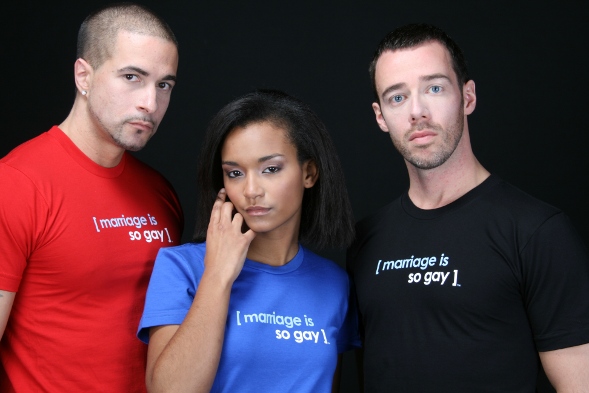
Alert Reader Karen points out that one half of a lesbian couple had to turn her "Marriage is So Gay" shirt inside out at Dollywood. That would be Dolly Parton, a gay icon, by the way. Clearly, she did not personally run the sensitivity seminars for the staff at this place, or she'd laugh in the face of someone suggesting that this was an appropriate course of action. At least, I hope so.

Karen's question is, "So if this shirt had been one of those 'man + woman = marriage' shirts, would that have been considered offensive as well?"

Probably not, even though that shirt is offensive, because it's coming from a place of bigotry. But those values are, in many ways, more mainstream, despite the fact that 53% of Americans support gay marriage. That fact notwithstanding, the number of self-identified evangelicals to self-identified queers is 10:1.

I have the same "marriage is so gay" shirt that the woman in question had to turn inside out. I have definitely noticed that people sometimes seem uncomfortable when I wear it, but I've never been asked to change, and I honestly don't care. I like making people uncomfortable sometimes. But these ladies had their kids with them, and didn't want to cause a scene, I get that. I'm glad they're doing something about it now - they're asking the park "to implement policies that are inclusive of lesbian, gay, bisexual and transgender people; conduct staff sensitivity training; and issue a public statement indicating that the park is inclusive of all families." Word.

The park's policy as of now is to ask people "with clothing or tattoos that could be considered offensive to change clothes or cover up." You know what I think is offensive? Asking people to hide their self-expression because someone at this park gets to decide what is acceptable, and what a family looks like, and what a person should put on their body. If you don't like tattoos, don't get one. But we seem to have this whole cultural idea that it's more important to protect people from seeing anything unpleasant than it is to allow people to express themselves. Aren't we supposed to be the land of the free? My tattoo or nose ring or whatever hurts you literally not at all, so just get over it, okay? And if my t-shirt slogan means you have to have a conversation with your kids, will the world cave in? Or if you have to have a conversation with yourself?

"But Jess! What if someone is wearing a 'God Hates Fags' shirt or sending their kids to school in a shirt that says 'Islam is of the Devil'?"

Look, I do think there's something of a difference here. Those messages of hate speech are just that, hate speech, and they are explicitly designed to make people feel unsafe and unwelcome. But I don't think they should be illegal either, we have to be able to deal with idiots productively. The shirts themselves aren't the problem here, it's the bigoted asshole fucks behind the shirts, and we need to get past them and their fabulous signs and talk about how we can make society so safe and accepting of everyone that fringe shitheels like these folks don't even register on our radar anymore.

We need to quit policing each others' bodies and what we put on them. Your swinging fist is your business until it hits my nose. Wear what you want, I may or may not like it, and you shouldn't care if I do.

Image via.